

End-to-end process · Record to Report (R2R)
From transaction to financial insight
Blocked invoices, open items, period-end - answered, not ticketed.
Finance teams spend their days explaining SAP to everyone else: why an invoice is blocked, what's still open on an account, where a variance comes from. Bridge answers those questions at the source - in Teams, in Outlook, across whole SharePoint folders - so your team can close books instead of tickets. Finance work spans the seams: invoice checks reach over from purchase to pay, closing and reporting live in record to report. This page covers what your finance team actually asks - wherever it formally belongs.
The grind today
Every blocked invoice becomes somebody's afternoon.
The requester asks the buyer, the buyer asks AP, AP digs through MIRO and FBL1N, and three handovers later the answer is "price variance". At period-end it gets worse: the same account questions, the same open-item hunts, under deadline. The knowledge sits in SAP - the time goes into retrieving it.
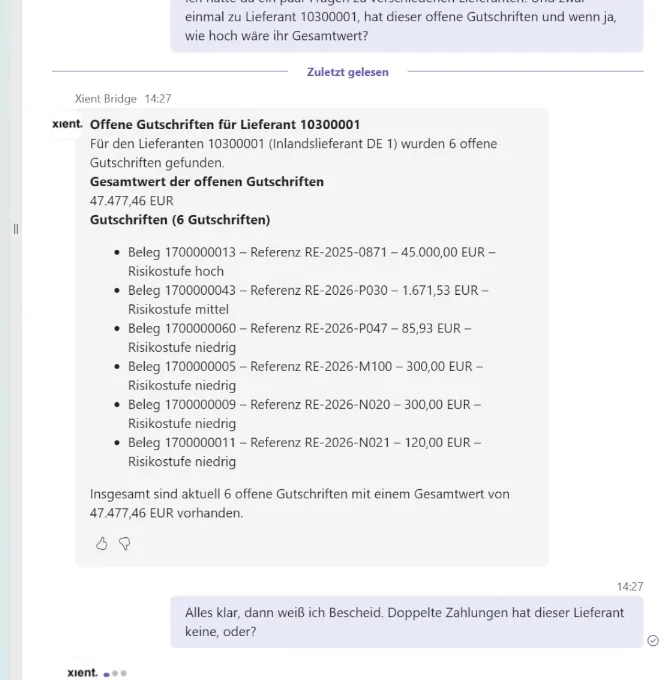
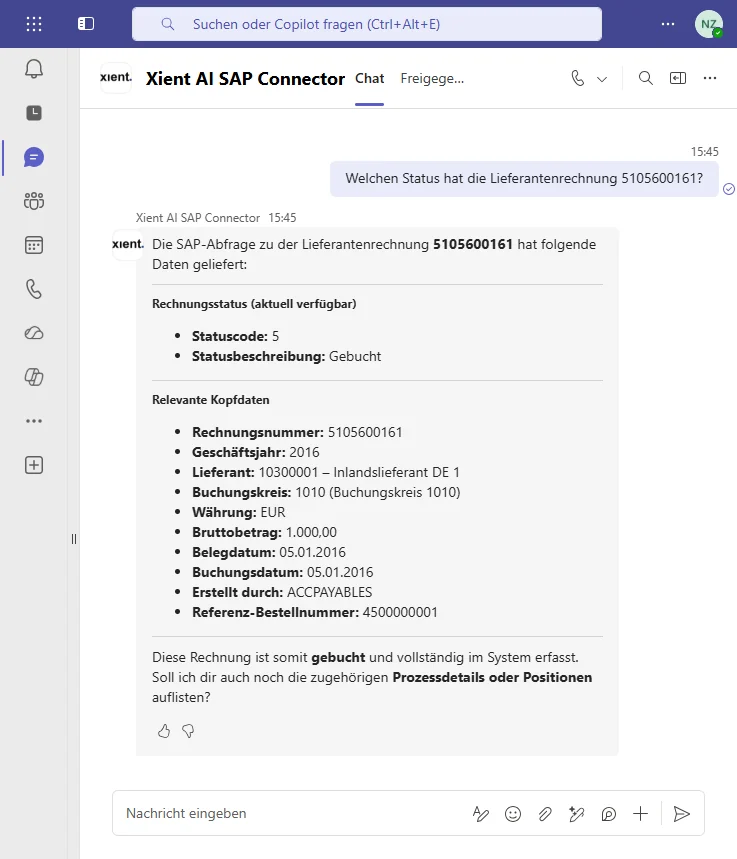
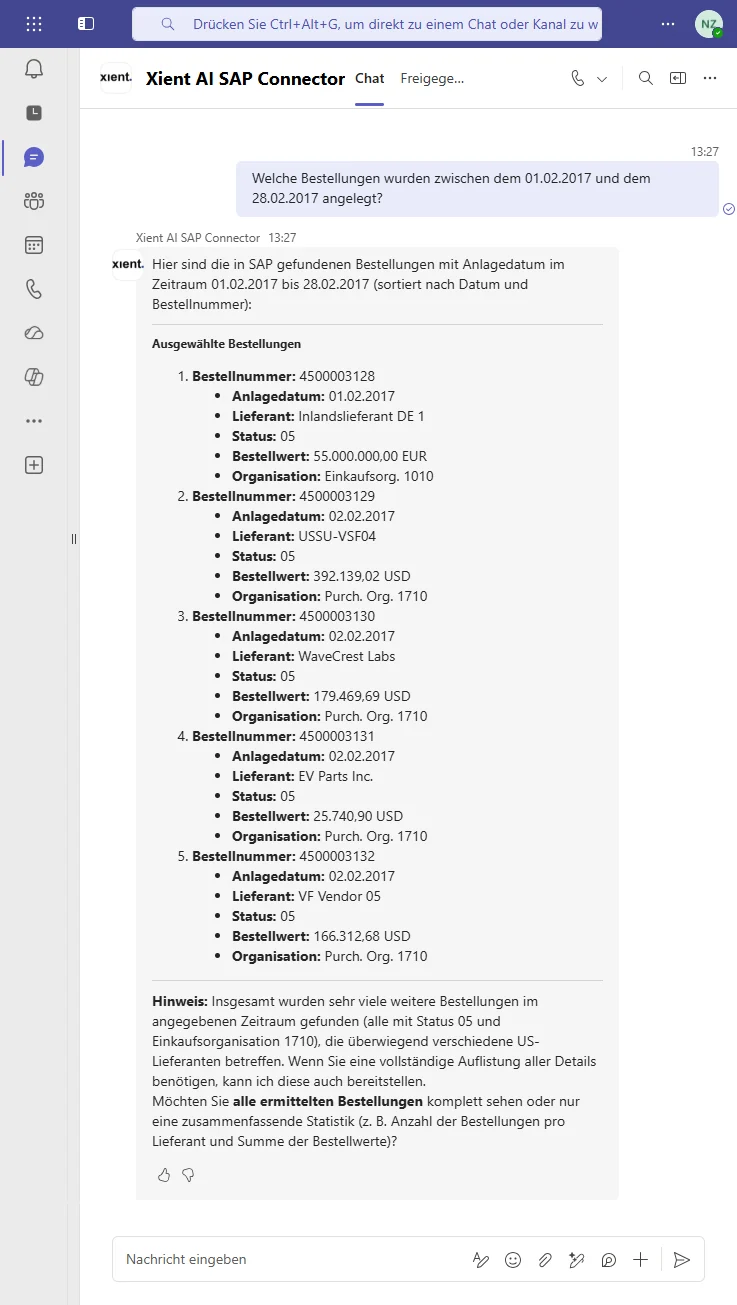
A real exchange
The answer, with the reason attached.
Four surfaces, one close
Finance questions come from everywhere. Answers should too.
 In Teams
Open items on an account, an invoice's payment status, a variance explained - answered in the channel where the question was asked, with the posting behind it.
"What's still open on account 160000?" In Outlook*
A supplier chases payment by email: pull the invoice's status without leaving the thread. A dunning note arrives as a PDF? Check it against the open items right there.
"Has this invoice been paid - and when?" In SharePoint*
Your invoice inbound as a watched folder: every arriving document is checked automatically against SAP master and transaction data - plausibility, correctness, duplicates, fraud patterns - and the findings filed right back.
"Check every incoming invoice - flag what's off." In Excel*
An invoice or document number in a cell: ask what's behind it - vendor, amount, payment status. Later phase: Bridge fills the neighboring cells with the findings.
"Which document sits in B2 - and is it paid?"Company knowledge
First knowledge source beyond SAP"How do I post this?" Bridge knows your manual.
The questions your AP veterans answer a hundred times a year: which tax code for this constellation, accrue now or expense it, reversal or credit memo, what the cash discount policy actually says. Those answers don't live in SAP - they live in your internal accounting manual. Bridge reads it right out of your Microsoft 365 workspace and combines the rule with the live document from SAP: your policy, applied to this invoice.
Accountants carry hundreds of these cases in their heads - and in the manual. Bring yours to the demo; that's the fastest way to see it work on your rules.
Under the hood
What Bridge reaches. What it can do.
Data sources
- Supplier invoices and payment status
- Journal entries and account balances
- Open items - payables and receivables
- Related purchase orders and goods receipts
- Your internal accounting manual and posting guidelines - from your Microsoft 365 workspace
- SAP data via released standard services - ECC and S/4HANA, no core modification
Capabilities
- Explain blocked invoices, with the reason
- Retrieve account information and balances
- Identify open items and overdue payments
- Explain variances and detect inconsistencies
- Answer "how do I post this?" from your own posting rules
- Answer period-end questions and prepare approvals*
*Outlook, SharePoint and Excel arrive in a later release. Write actions are planned for later phases - released explicitly, function by function, under your governance. Bridge starts read-only. Excel as a surface also arrives in a later release.
Every access runs through the user's own SAP account - nobody sees more than their SAP rights already allow. Everything stays in your Microsoft tenant, auditable end to end.
Why it pays
Where the time comes back.
See the finance workflow live.
Thirty minutes, your invoice and account questions, a live system.